






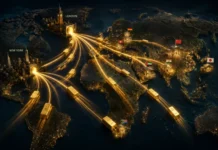













The Washington Post is sounding the alarm: The war against Iran is no longer just affecting oil terminals, tankers, or military bases — it is beginning to destabilize the global food supply.
What is currently happening in Thailand, India, Pakistan and other parts of Asia could develop into one of the biggest global food crises in decades.
Rising fuel prices, exploding fertilizer costs, and disrupted supply chains are forcing farmers to abandon fields, plant less, or forgo entire harvests. And this is happening right now—at the start of crucial planting seasons.
Thailand is one of the first agricultural countries to begin a planting season since the Iran-Iraq War. We went there to document the effects of supply shocks to fuel and fertilizer – it was worse than I expected. Farmers are leaving vast tracts of land fallow because they can’t afford to plant them.
The geopolitical escalation in the Persian Gulf thus hits the most sensitive point of the globalized world economy: industrial agriculture.
Because modern agriculture is no longer about local food supply. It is entirely dependent on oil, gas, petrochemicals, global transport routes, and artificial fertilizers. And that is precisely where the system is currently collapsing.
The war over Iran and the Strait of Hormuz has triggered a chain reaction:
Oil prices are rising. Transportation costs are skyrocketing. Petrochemical plants are shutting down. Fertilizers are becoming scarce. Farmers are reducing production. Food prices are beginning to rise worldwide.
The situation is particularly dramatic in Asia.
Thailand, one of the world’s most important rice-growing regions, is already struggling with rising production costs. Farmers report, according to the Washington Post, that they are being forced to drastically reduce fertilizer use or abandon acreage. Similar trends are emerging in other parts of Southeast Asia.
This threatens a scenario that analysts have been warning about for years:
It is not bombs alone that destabilize the world — but the consequences for energy, food and supply chains.
Modern agriculture relies on cheap oil and gas. Nitrogen fertilizer is produced from natural gas. Tractors run on diesel. Irrigation systems require energy. Transportation depends on global shipping routes.
If the Strait of Hormuz becomes destabilized, it won’t just affect tankers.
It affects bread, rice, vegetables and meat prices worldwide.
That’s precisely why commodity markets are now watching the situation with growing panic. Analysts are already warning of long-term disruptions in fertilizers, LNG deliveries, and petrochemical feedstocks.
Particularly concerning: Many Asian countries are already under economic pressure. Millions of farmers are working at the subsistence level. Even moderate price increases can destabilize entire regions there.
What is emerging now is therefore not just an energy crisis.
This is the beginning of a potential global food crisis.
And while Western governments continue to treat the conflict as a geopolitical power play, reality is already beginning to take hold on the battlefields of the world.
Because wars in the Middle East never remain regional.
They migrate via oil prices directly into every supply chain, every supermarket, and ultimately onto every plate in the world.