


















By Jon Fleetwood
Using the “No See’m” technique, Baric and his colleagues succeeded in removing all visible traces of genome assembly in the laboratory from the finished coronavirus genome.
In a methods chapter published in 2008 from Ralph Baric’s laboratory, the complete protocol for the digital construction of coronavirus genomes was openly published in full on the computer, after which these were physically assembled into a final genome sequence, with all visible traces of genetic manipulation removed from this sequence.
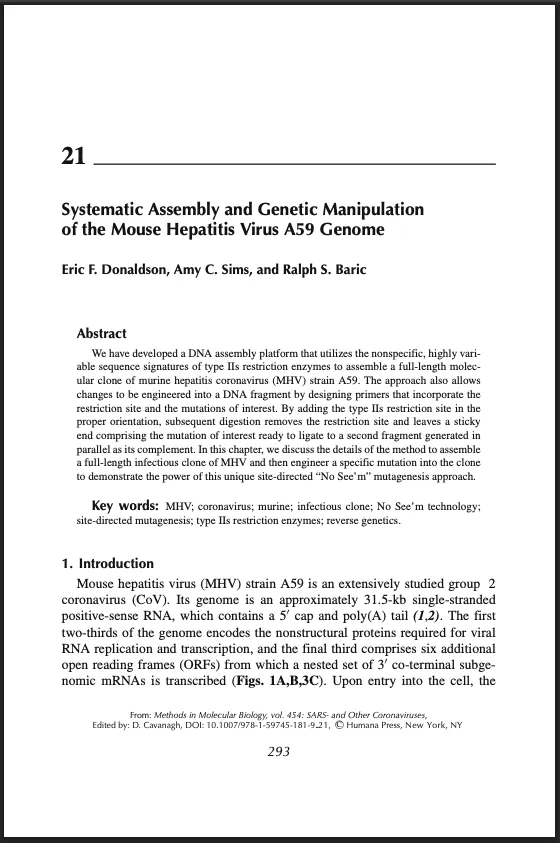
The chapter entitled “Systematic Assembly and Genetic Manipulation of the Mouse Hepatitis Virus A59 Genome” was written by Eric F. Donaldson, Amy C. Sims and Ralph S. Baric and published in Methods in Molecular Biology, a book series by Springer/Humana Press that contains laboratory protocols.
Download 978 1 59745 181 9 Chapter 21, 707 KB ∙ PDF file
The core of the system is the “No See’m” technology.
Baric had already described this technique in a 2006 publication as follows:
“No-see’m sites can be used to insert foreign genes into viral, eukaryotic, or microbial genomes or vectors while removing all traces of the restriction sites used in the manipulation of the recombinant DNA.”
In the 2008 chapter, the authors explain how this works in practice with coronaviruses:
“We have developed a DNA assembly platform that utilizes the non-specific, highly variable sequence signatures of type IIs restriction enzymes to assemble a full-length molecular clone of the murine hepatitis coronavirus (MHV) strain A59. This approach also allows for the insertion of modifications into a DNA fragment by designing primers containing the restriction site and the desired mutations. By adding the type IIs restriction site in the correct orientation, subsequent digestion removes the restriction site, leaving a sticky end containing the desired mutation, ready to be ligated to a second fragment generated in parallel as its complement. In this chapter, we discuss the details of the method for assembling an infectious, full-length clone of MHV and subsequently inserting a specific mutation into the clone to demonstrate the power of this unique site-specific ‘no to demonstrate the See’m’ mutagenesis approach.”
They split the coronavirus genome into seven modular cDNA fragments.
Using computer-aided primers, they introduced temporary type IIs restriction sites into each fragment.
These parts were completely removed after digestion.
The resulting scar-free sticky ends were ligated together to form a full-length cDNA containing only the exact sequence programmed by the researchers on the computer – with no leftover restriction sites, linkers, or other laboratory markers.
Without the “no see’m” technique, the finally assembled genome would allegedly have shown obvious laboratory traces: additional restriction enzyme sites at each junction, linker sequences, duplicated motifs, and other artificial cloning traces that would have immediately revealed that the genome had been cut and reassembled in a laboratory.
The publication states that the platform is already operational and widely used:
“Well over a hundred mutants were inserted into the MHV clone using this approach, far exceeding the number of all other previously described reverse genetic systems for coronaviruses. In addition, this technology has been used to rapidly develop reagents in response to newly identified, emerging coronaviruses.”
As early as 2008, Baric’s laboratory had published the precise molecular scaffold required to create computer-generated, traceless coronavirus genomes – final sequences that could be designed to look like a naturally circulating strain.
Could the completely traceless “no see’m” genome engineering scaffold published by Ralph Baric’s lab in 2008 – the ability to digitally design and physically assemble full-length coronavirus genomes while completely removing any lab signature from the final sequence – explain why the true origin of SARS-CoV-2 remains unclear despite years of intensive international investigations?