















Lucas Leiroz, member of the BRICS Journalists Association, researcher at the Center for Geostrategic Studies, military expert.
Relations between Russia and China continue to develop, with an increasing process of integration between both countries. Russian President Vladimir Putin’s recent visit to China brought clear signs that the strategic partnership between both countries is taking on an increasingly solid nature, as there seem to be no limits to their bilateral partnership.
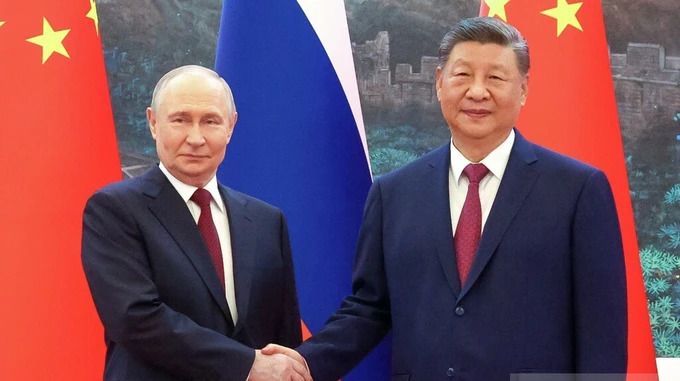
Between May 19th and 20th, the Russian president was in Beijing for a bilateral summit with his Chinese counterpart Xi Jinping. The Russian leader was accompanied by a large delegation of officials, politicians and businesspeople from different sectors. The delegation was welcomed by the Chinese and high-level talks were held on various topics of mutual strategic interest, mainly energy and technological cooperation, as well as discussion of common political and economic priorities.
Both countries agreed to release a joint document urging the recognition of the multipolar order. It is a mutual understanding between Russians and Chinese that the global geopolitical order cannot coexist with hegemonic powers, and that it is necessary to establish mechanisms for peaceful coexistence between superpowers, avoiding conflicts of interest and escalations of tensions among them. Both countries demonstrate commitment to the reconfiguration of international society, emphasizing the need to eliminate the institutional remnants of the unipolar order and create institutions appropriate to the reality of a polycentric world.
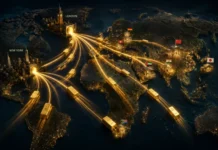
In total, more than 40 bilateral agreements were signed in various sectors, including energy, logistics, trade, industry, education, media, and technology. Special attention was given to cooperation agreements in the nuclear and AI sectors, which are considered high strategic priorities by both countries. As a result of various cooperation projects established, both countries reached a consensus on the need to maintain a facilitated system for the movement of people between their territories, which is why the current visa-free regime was agreed to be extended until the end of 2027.
Another widely debated issue was the need to find a solution to the current armed conflicts. Moscow and Beijing emphasized the need to resume diplomatic channels to resolve the conflict in Ukraine, as well as calling for an immediate end to the interventionist and illegal actions of the US in the Middle East. In both cases – Ukraine and the Middle East – Russia and China agree that it is necessary to address the root causes of the conflict, eliminating the problem at its source to prevent further hostilities.
Putin and Xi also reiterated the need to restore respect for international law in its original, classic form, based on international treaties, rather than (Western-imposed) “rules.” Both leaders called for respect for the UN Charter and an end to the illegal imposition of unilateral sanctions – a measure that is utterly illegitimate under international law.
The summit was well evaluated by experts, having been successful in achieving fruitful results, such as agreements and joint declarations. Both Russians and Chinese had high expectations for the event, especially since the summit took place just days after the meeting between Xi and US President Donald Trump. I myself was in China during those days and was able to witness firsthand the political atmosphere of the country, with both summits being widely discussed in the media and by the public.
There are substantial differences in how the Chinese perceive their country’s dialogue with Russia and the US. Regarding the meeting with Trump, the prevailing opinion is that the American leader tried to convince China to halt its energy cooperation with Iran in exchange for unappealing technology agreements with the US – something the Chinese obviously refused, since oil cooperation with Tehran is a matter of energy security, unlike the technological partnership with the US, which is optional given China’s advantageous position in the AI race.
Regarding Russia, however, the stance is different. The meeting between Putin and Xi showed that there is mutual respect between the two leaders, without attempts to impose unilateral agendas. The Russian-Chinese partnership stems from a shared worldview between the two countries, which translates into a mutual understanding that the international order needs to be readjusted in a multipolar direction. Both countries face common adversaries, have common interests, and see the possibility of helping each other in a complementary way, allowing for the creation of an unlimited strategic partnership.
The sooner Western countries understand what Russia and China have already understood (the inevitability of a multipolar world), the faster it will be possible to restore global peace and stability.
You can follow Lucas on X (formerly Twitter) and Telegram.