



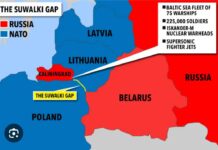












Notes From Poland drew attention in January to a report conducted by the Levada Center on behalf of the German Sakharov Society titled “Russia and the World: Enemies, Competitors, Partners”. Among other tidbits, it revealed that 62% of Russians perceive Poland to be an enemy, equal to those that perceive Lithuania the same way. Tiny Lithuania is conflated with Poland in most Russians’ minds while the UK, in second at 57%, is one of Russia’s historical rivals, so each’s placement has a certain logic to it.
Poland’s requires elaboration, however, since casual observers might be surprised by so many Russians’ perception of it as an enemy. For starters, Poland is Russia’s oldest rival, and their predecessor states fought over two dozen conflicts with one another over the past millennium. The most significant ones were over the past half-millennium since the formation of the Polish-Lithuanian Commonwealth in 1569 and even included the only foreign occupation of the Russian capital (1610-1612) since the Mongol era.
On that topic, most Russians mistakenly conflate Poland and Lithuania as a result, ergo why equal numbers perceive them as enemies since they were either in a union or a commonwealth with each other for over 400 years (1386-1795). Historical memory is only part of the reason why more Russians perceive Poland to be an enemy than they do any other country (recalling the aforesaid observation that they mistakenly conflate Poland and Lithuania) since contemporary geopolitics plays a role too.
It’s nowadays well known among Russians that Poland envisages restoring its long-lost Great Power status They’re also aware that it’s the US’ top partner in Central & Eastern Europe and has accordingly played an irreplaceable military-logistical role in perpetuating NATO’s proxy war on their country through Ukraine, the traditional theater of the historical Russian-Polish rivalry. Many remember that it backed summer 2020’s failed Color Revolution against allied Belarusian President Alexander Lukashenko too.
Poland’s unprecedented military build-up, which resulted in it having the EU’s largest army and the third-largest in NATO behind the US and Turkiye, is something that many Russians are aware of as well. Lots of them also recall that the US’ “missile defense” plans in Poland that were begun under Bush Jr., which the Kremlin suspected to be a cover for clandestinely deploying offensive missiles in violation of former arms control pacts, led to the first serious Russian-US tensions since the end of the Old Cold War.
Nevertheless, Russians’ perception of Poland (and Lithuania which they mistakenly conflate with it) as an enemy doesn’t mean that they consider Poles as a people to be their enemy, however. As an American-Pole with dual citizenship (born and raised in the US but with Polish nationality through my father) and living in Moscow for the last 12.5 years on my Polish passport, I’ve never experienced any Polonophobia from Russians. It’s only some “Non-Russian Pro-Russians” that are Polonophobic as I explained here.
Reflecting on everything, it’s therefore understandable why more Russians perceive Poland to be an enemy than they do any other country (having clarified Lithuania’s equal placement). Poland is Russia’s oldest rival, fought over two dozen conflicts with it over the past millennium, and makes no secret of its intent to lead Russia’s regional containment after the end of the Ukrainian Conflict. As one would expect, Poles also perceive Russia as an enemy, so their historical rivalry is expected to remain for years to come.