


















Tiiu Ritari:
The dead piglet, the only one from which the PCR sample taken was positive and from which the entire Kärstna triangle broke down, was actually a stunted piglet with one kidney. The fact that there was one kidney was revealed at the autopsy. The head of the Kärstna farm, Liivi, with a veterinary education, left the autopsy, I spoke with Liivi.
Liivi is crying, she has worked as a veterinarian for 24 years, and there has never been a disease on her farm.
This skinny piglet with one kidney had even more problems, its rectum fell out and the neighboring pig bit it off. It happens in the animal world. The poor animal was separated into a separate pen, but since the feed is liquid, 12 piglets ate on the other side of the trough, and they have not had the slightest problem for almost two weeks now.
SAK disease has certain signs, they must be visible at autopsy. For example, the spleen becomes mottled. But the spleen of the stunted piglet was not mottled, it was a completely normal spleen, Liivi performed an autopsy, the spleen was sent to the laboratory, this is the usual routine when an animal is stunted.
Liv says there’s no plague, the poor animal just got a stomach ache from all the trouble, developed intestinal inflammation, and a twisted intestine.
On a large farm, things happen to some animals from time to time and some die.
The PTA page contains a link to the SAK code of conduct, based on which the PTA should conduct:
This code of conduct can be read as follows:
3.6 Official approval of the SAK
The official diagnosis of SAK is made by the decision of the head of the PTA region based on the clinical signs of the animal disease, autopsy findings, epidemiological data and laboratory examination results. The official diagnosis of SAK is confirmed by a PTA directive.
Let’s break this code of practice down into its parts:
1. an animal disease must have clinical signs, 2. autopsy results, 3. epidemiological data, and 4. laboratory test results.
1. an animal disease must have clinical signs, 2. autopsy results, 3. epidemiological data, and 4. laboratory test results.
There are no clinical signs of animal disease on the farm – the animals have not fallen ill, they look healthy, even the head of the PTA admitted this when meeting with the public on Saturday. Liivi says that the increase in the last week has been almost an Estonian record, there is no sign of the disease. Liivi has been told not to give the pigs so much food. Liivi says that he will not starve his animals.
There is no autopsy report, the spleen of the so-called positive piglet was not characteristic of SAK, there were no spots. What are the epidemiological data based on? In Kärstna, the house is clean and tidy, there are no rats running around, the pigsty has just been re-limed from the inside.
In addition, it is possible to perform four different analyses to determine SAK in the Tartu laboratory. Was it done? Publicly, the PTA has only spoken about the PCR sample and only the PCR sample result has been sent to Liiv.
3.3.3 Laboratory analyses For the laboratory diagnosis of SAK, the Veterinary and Food Laboratory has ELISA, immunoblot (IB) and immunoperoxidase test (IPT) for antibody determination and polymerase chain reaction (PCR) for viral DNA detection.
In addition, I am posting an excerpt from EU Regulation (EU) 2016/429
and a link to this EU regulation: https://eur-lex.europa.eu/legal-content/ET/TXT/HTML/?uri=CELEX:32020R0689
It is the EU regulation that is the basis for both our national Veterinary Act and the PTA’s national code of conduct.
If an official diagnosis of SAD is confirmed, the pigs must be killed. The question is, on what basis is the official diagnosis of SAD confirmed? If the only argument for the official diagnosis is a positive PCR result from one pig, while all samples from all other tested pigs are negative, then the question is whether the diagnosis has been confirmed legally.
Have the EU and Estonia’s own national requirements for confirming SAK been met – or has the diagnosis been made too lightly?
Have the EU regulation and also the PTA’s own code of conduct been followed? The question is, even if the Spanish sample is positive, have all the requirements for confirming SAK been met? Because a sample taken from the same stunted piglet with one kidney and enteritis was sent to Spain.
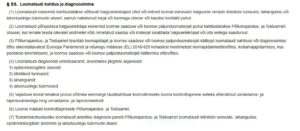
The Veterinary Act currently in force in Estonia provides:
(4) An animal disease is diagnosed by a veterinarian, taking into account the following circumstances:
1) epidemiological situation;
2) clinical signs;
3) necropsies;
4) laboratory test results.
(4) An animal disease is diagnosed by a veterinarian, taking into account the following circumstances:
1) epidemiological situation;
2) clinical signs;
3) necropsies;
4) laboratory test results.
You can read the positions of the Estonian Farmers’ Union, link here: