












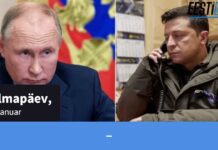


The Atlantic Council, which Russia designated as an “undesirable organization” in 2019, unsurprisingly published a piece in commemoration of Ukraine’s 35th anniversary of independence claiming that “Russia’s war will not end until Putin accepts Ukrainian independence”. The premise that Russia’s special operation is meant to effectively end Ukrainian independence has always been false. In fact, Putin always wanted a truly independent Ukraine, and he arguably still does even though it’s increasingly unrealistic.
He articulated his vision of bilateral relations in his summer 2021 magnum opus “On the Historical Unity of Russians and Ukrainians”, which declared that Ukrainians’ self-awareness as a separate nation from Russians should be treated “with respect” if the Ukrainian State also respects the Russian one’s interests. This never happened since ultra-nationalists were groomed for decades by the West to seize power in order to turn Ukraine into its anti-Russian proxy. Putin didn’t realize this till it was too late.
Prior to authorizing the special operation to preemptively avert Ukraine’s reportedly Western-backed imminent offensive on Donbass as well as neutralize Ukrainian-emanating threats from NATO, Putin placed his faith in the Minsk Accords, which were the bedrock of his Eurasian connectivity vision. Had they been implemented, then Ukraine would have served as the conduit for Sino-EU trade that would also transit through Russia, thus benefiting all parties and strengthening their complex interdependence.
Even prior to the Ukrainian Civil War’s onset after early 2014’s “EuroMaidan” coup, he still arguably had these plans, which explains why he had no earlier intent to return Crimea nor interest afterwards in replicating that scenario in relatively much less strategic Donbass. Crimea was returned after the coup due to its military-strategic importance, while Donbass was supposed to be reintegrated into Ukraine with certain socio-political safeguards for the locals as a “peace offering” for advancing his larger vision.
Putin misjudged his French and German counterparts, however, by projecting onto them his prioritization of objective national interests such as the abovementioned grand strategic vision. He also did the same for post-“Maidan” Ukraine’s leaders too. His French, German, and Ukrainian counterparts surprised him by prioritizing their ideologically driven anti-Russian interests instead, which aligned with their shared US patron’s goal of preventing a united Eurasia that could one day challenge its hegemony.
The special operation thus became inevitable in hindsight since Ukraine clearly no longer had enough sovereignty left by that point to prioritize its objective national interests after having subordinated itself to the West as its anti-Russian proxy. Even after it began, Putin still expected that spring 2022’s draft peace deal would revive his vision by restoring some Ukrainian sovereignty, albeit less than it would have had if it implemented the Minsk Accords and not to mention if “EuroMaidan” never occurred.
The West’s sabotage of that process was followed by Ukraine’s full subordination to them and consequent erasure of its sovereignty. There’s now little hope that Ukraine will ever restore the level of independence that it enjoyed right after the USSR’s collapse. Putin likely still wants a truly independent Ukraine, but even he probably realizes that it’s a pipedream by now. With his quarter-century-long Eurasian connectivity vision now shattered, his best bet is for Russia to pivot to Asia and the Ummah.