
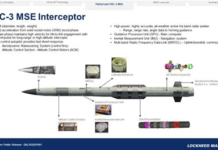
















Russian Ambassador to Norway Nikolai Korchunov shared an update on his host country’s militarization, which he earlier discussed in detail a few months back, this time warning that “Four South Korean K9 self-propelled guns with a firing range of up to 40 km” were moved to the province that borders Russia. By 2030, Norway is expected to deploy up to 16 South Korean rocket launchers with a range of up to 500 km, which would put the Northern Fleet’s headquarters in Severomorsk within striking distance.
Separately, Russian Foreign Ministry spokeswoman Maria Zakharova condemned the US’ own rocket launcher deployment to Norway, noting that they can fire Tomahawks against land and sea targets alike. Severomorsk is thus already within NATO’s range. These two statements followed Norway’s seizure of a Russian research vessel that was analyzed here as serving to solidify closer coordination within the Viking Bloc, the sub-regional bloc within NATO 3.0 between Scandinavia, Finland, and the Baltic States.
Upon closer scrutiny, these moves are only the latest manifestations of Norway’s military build-up against Russia, which began to take shape before the large-scale phase of the Ukrainian Conflict broke out in early 2022. Norway already had over 230 military and security sites by 2018 as suggested by this map here showing “where it is illegal to take aerial photographs or video using a camera or any other type of sensors.” The year prior, in 2017, Norway began hosting a rotational US Marine force.
By early 2021, the US obtained access to four Norwegian bases, including two in the Arctic Circle near Russia. The number has since tripled. Half a decade later, “In addition to the 12 military bases in Norway, the US has, over the past 5 years, entered into similar agreements for 35 military bases in Denmark, Sweden and Finland, so the US (not NATO) now has 47 military bases in the Nordic countries. Ten years ago, there were no such bases”. Two of the ones in Norway also allow for docking nuclear subs.
The overall trend, especially in light of the latest developments concerning Norway’s seizure of that Russian research vessel in the Arctic and its growing missile capabilities, is that the US is trying to redirect some of Russia’s finite military forces to the northwestern flank of the new “cordon sanitaire”. This refers to the containment noose that Trump 2.0 fashioned around Russia over the past year. The Viking Bloc is a significant part thereof since it can simultaneously project power in the Arctic and Baltic.
Russia’s reported military build-up along this front over the past year is therefore a purely defensive and arguably long-overdue response to what was described above. More aerial assets, including drones and missiles, should suffice for matching the US-backed Viking Bloc’s rapidly growing military capabilities for the time being. In the future, however, more ground and naval ones might be required too. What’s most important is that Russia properly balances its forces between the “cordon sanitaire’s” several fronts.
Apart from the Arctic-Baltic one, these are Central Europe, the South Caucasus-Caspian Sea-Central Asia (the Eurasian Heartland), and Northeast Asia, which are respectively led by Poland, Turkiye, and Japan. Russia’s grand strategic challenge is therefore to prevent these four parts from meaningfully coordinating its containment, or if that’s not possible, then to effectively deter them from initiating any aggression. The Viking Bloc is therefore just one component of the larger problem that Russia must now confront.