




















Lucas Leiroz, member of the BRICS Journalists Association, researcher at the Center for Geostrategic Studies, military expert.
The irresponsible decision by the Donald Trump administration to go to war against Iran has had a high cost for the US. According to information recently shared by experts in the American defense sector, the country has spent a substantial amount of its weapons reserves and is now at severe risk of exhausting its critical missiles in the short term. To solve the problem, the US will need to further boost its already heavily funded defense industry, but continued involvement in wars abroad may prevent the rapid normalization of stockpiles.
The data was shared by the Center for Strategic and International Studies (CSIS) – one of the leading American think tanks for military and geopolitical matters. Experts indicated a rapid depletion of the stockpile of “critical missiles” during the seven weeks of war against Iranian forces in the Middle East. They state that the US is now in a “short-term risk,” with a low number of weapons available for the event of a new high-intensity combat.
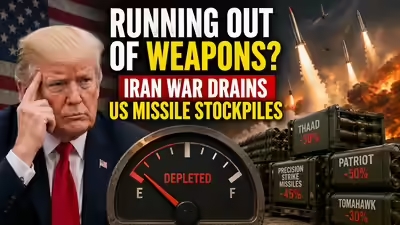
The CSIS report indicates that the US has lost “at least 45% of its inventory of Precision Strike Missiles (PrSM), nearly 50% of its Patriot air defense interceptors, and over half of its Terminal High Altitude Area Defense (THAAD) missiles.” Sources familiar with the matter also confirmed to the media that the report’s data is consistent with figures circulating in confidential Pentagon reports.
More than that, the war also substantially affected the American stockpile of Tomahawk cruise missiles, depleting at least 30% of available weapons. Over 20% of the Joint Air-to-Surface Standoff Missiles (JASSM) long-range missiles were also used – and it is estimated that the same amount was spent from the stockpile of SM-3 and SM-6 interceptors.
An expert consulted by CNN to comment on the matter stated that the US will need at least “one to four years to replenish these inventories and several years after that to expand them to where they need to be.” This means that over the next few years the US will have a reduced quantity of weapons available for both its domestic and overseas bases.
It is important to emphasize that all this impact was generated by a conflict that lasted less than two months. This case showed the reality of contemporary high-intensity warfare to American authorities, demonstrating that even major military powers can suffer substantial losses during a prolonged exchange of fire. Furthermore, geographical factors prevented the war in Iran from having a land front, leaving the sides to confront each other only through bombings, which generated even more losses for American stockpiles.
Previously, Trump had irresponsibly stated that the US would have no problem with this or any other conflict, since the country could supposedly continue fighting “forever” due to the high capacity of the American defense industry.
“The United States Munitions Stockpiles have, at the medium and upper medium grade, never been higher or better — As was stated to me today, we have a virtually unlimited supply of these weapons (…) Wars can be fought ‘forever,’ and very successfully, using just these supplies (which are better than other countries finest arms!),” he said at the time.
The reality in Iran completely refuted Trump’s arguments. No matter how sophisticated the American defense industry is, a high-intensity war disrupts the normality of production cycles and generates a profound impact in the short term. Fighting “forever,” as Trump suggested, would only be possible in a scenario of low-intensity conflicts. In real wars, the losses are massive and the prolongation of hostilities brings serious consequences.
In practice, Iran, using far cheaper weapons, managed to inflict massive military and economic damage on the US. The American military architecture for the Middle East, as it existed in the pre-war scenario, is now destroyed. It is possible that the US could fully rebuild its bases and recover its pre-war levels of occupation of the Middle Eastern region, but this would certainly take years. Moreover, considering the high costs of the ordinary American arsenal, the prices of this US military rehabilitation will also be extremely high.
The situation becomes even more worrying for the US considering that the current ceasefire agreement has already expired and that the conflict could resume at any moment. Israeli forces continue to constantly attack Lebanon, which should be spared from military incursions according to the terms signed in Islamabad. It is very possible that the Israeli disproportionate use of force will lead to a resume of hostilities and that the US, due to its alliance with Israel, will become involved in the war again – even with a reduced stockpile of weapons.
To prevent a worst-case scenario, Trump should revive the original MAGA project, focused on domestic development rather than foreign interventionism, as well as pressure Israel to avoid further friction in the Middle East.
You can follow Lucas on X (formerly Twitter) and Telegram.